Showing posts with label CES11. Show all posts

Sunday, January 16, 2011

GlobalFoundries focusing on Fab upgrades and new facilities in New York and Abu Dhabi in 2011


AMD's fabrication spin-off, GlobalFoundries, is betting heavily on the future of semiconductor production being outsourced by 'fabless' chip makers. So much so, in fact, that it's planning to spend $5.7 billion on upgrading its facilities this year alone.

The planned expenditure, which is double what the company spent in 2010, was reported to Bloomberg by GlobalFoundries' chief financial officer Robert Krakauer during an interview.

Krakauer claimed that the figure is 'based on customer programs and requests, [and not] speculative.' According to Krakauer, the money will be used to upgrade the company's fabrication facility in Dresden, build an additional facility in New York to begin production in 2012, and lay the groundwork for a new fab in Abu Dhabi.

Continue Reading...

via Bit-Tech

Friday, January 14, 2011

Qualcomm presents its dual-core Snapdragon mobile processors


NVIDIA's Tegra 2 was tearing it up on the CES 2011 show floor in a host of new tablets, but unbeknownst to us, Qualcomm's long-awaited dual-core Snapdragon made a pair of cameo appearances as well. The first was in ASUS' Eee Pad MeMO, which showed off its pressure-sensitive stylus action on the floor, and the second is in the new Qualcomm reference design you see immediately above. According to a video released on Qualcomm's website -- which you can watch after the break -- Qualcomm attempted to distract tech journalists from Verizon's press conference by giving them a sneak peek at the HTC Thunderbolt here instead. Then, we like to imagine, the company brainwashed the lot into believing the 1.2GHz MSM8660 with Adreno 220 graphics is destined for a host of tablets and phones. Of course, if that's actually the case, we'll gladly join the throng. Where do we sign up?

via Engadget

Tuesday, January 11, 2011

CNET names Nvidias Tegra 2 powered Motorola Xoom tablet "Best of CES 2011"


"Motorola today revealed its new Android-based Xoom tablet, which the company hopes will dethrone Apple's iPad in this fast-growing market segment.

The Xoom betters the iPad in some ways--it comes standard with front- and rear-facing cameras, including one that can record in HD, compared with none in the current version of the iPad. It also boasts a larger screen with a higher resolution, supports Adobe Flash, and uses Verizon's network instead of AT&T's. 
It will become the first device to run the latest version of Google's Android operating system, known as Honeycomb. The operating system supports multitasking and has been designed explicitly for tablets." - CNET

In addition to that, the tablet also features Nvidias 1GHz Tegra 2 dual-core processor which gives the tablet the ability to encode full 1080p video, power two displays and offer better overall graphics, while using less power than its predecessor. The tablet also hosts 1GB of DDR2 memory and 32GB of flash storage.

Continue Reading...

via CNET

Monday, January 10, 2011

CES 2011 wraps up and attracted over 140,000 attendees


Well, thats a wrap. CES 2011 was a major success, CEA estimated that 126,000 attendees would attend the 4 day long "gadget fest" this year and were happy to announce that around 140,000 attendees actually visited the convention.

"The Consumer Electronics Association's announcement likely wasn't a surprise for anyone that attended the event in Las Vegas. Attendees faced long lines for taxis and the city's monorail throughout the convention, which was a preliminary sign that attendance had rebounded." - PC World

They've also announced a small scheduling change for next years CES, and will be running the show from Tuesday to Friday, January 10-13. 

Be sure to check out what mattered most to us from CES here. Also, check out Engadgets CES 2011 coverage hub here for a wider range of amazing products that made their debut at the convention.

MSI's AMD 990FX based Bulldozer motherboard spotted at CES


During our visit to the MSI suite at the lovely Aria hotel today, we spotted an upcoming MSI motherboard called the Big Bang Conqueror just sitting around which we believe is based around the AMD 990FX chipset. This chipset will support future AM3+ processors from AMD and it will be AMD's top dog for overclockers and gamers.

While we didn't get too many details on the chipset itself, from looking at the board itself we could make quite a few assumptions. The first and third blue PCI-E graphics slots will operate at 16 lanes for full speed AMD Crossfire support and the memory setup uses a standard dual-channel DDR3 configuration. As far as the MSI specific details go, we see the addition of the new Military Class II, OC Genie, SATA 6G, USB 3.0 and more. 

Image of the upcoming socket after the break. 

via TweakTown 

Sunday, January 9, 2011

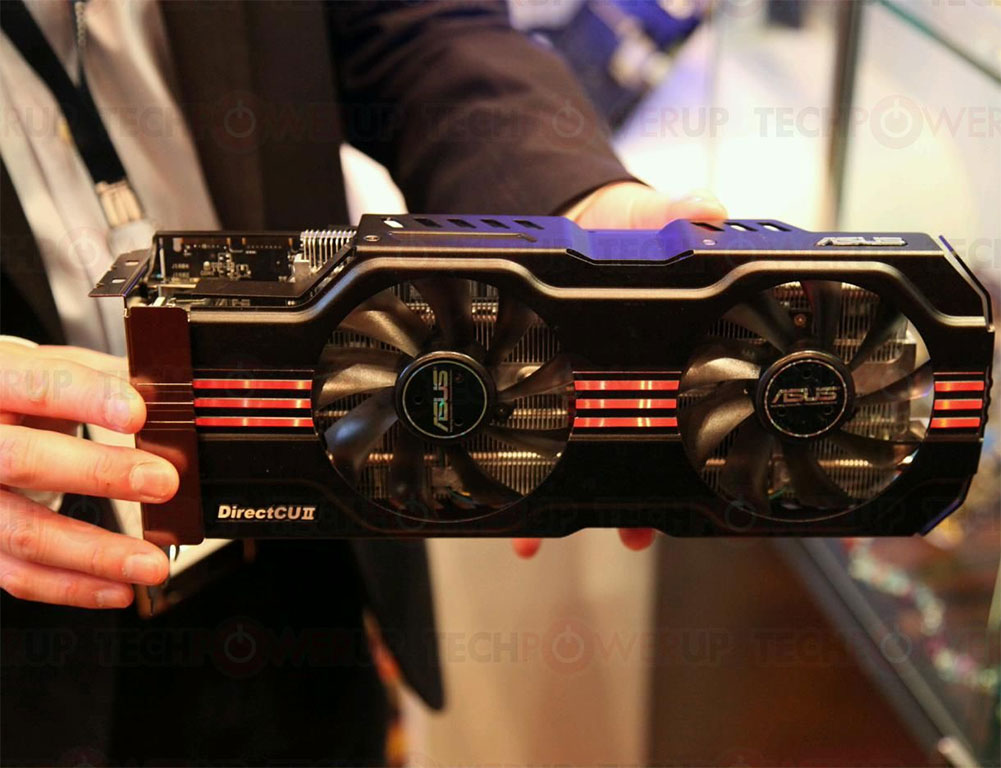
Asus prepares to unleash its Radeon 6970 DirectCUII graphics monstrosity.


ASUS displayed a huge new graphics card based on the AMD Radeon HD 6970 GPU. The EAH6970 DirectCu is perhaps the largest among the company's graphics cards that use a "direct-copper" GPU cooler in which heat pipes make direct contact with the GPU die. Such is the size of the cooler, that the card requires three expansion slots in your system. To make optimal use of the expansion brackets, ASUS wired out all TMDS links from the GPU, yielding a display connectivity consisting of two DVI and four full-sized DisplayPort 1.2 connectors.

The GPU cooler makes use of a large aluminum fin array which uses at least three 8 mm thick copper heat pipes. The aluminum fins are cooled by the airflow of two 120 mm fans. The card uses 2 GB of high-speed GDDR5 memory over a 256-bit wide memory interface, it packs 1536 VLIW4 stream processors. The card also seems to be using a 9-phase VRM that allows software voltage control. Power is drawn in from two 8-pin PCI-E power connectors.

See more images of the card after the break.

via TechPowerUp

Saturday, January 8, 2011

Have a sneak peek of Sapphires upcoming P67 based motherboard


We've already shown you Sapphire's mini-ITX Brazos board and no-one was overly surprised at seeing this motherboard, especially as Sapphire is a long term AMD partner. However, what we have for you today is an exclusive look at a not quite final P67 chipset motherboard from Sapphire, a product that many didn't expect to launch.

The board is clearly far from the final version and it even carries a Rev: 0.0 tag, but it’ll give us a good glimpse into what Sapphire is working on. The board is currently known as the PC-CI7S42P67 but we’re certain that Sapphire will come up with a much catchier name for the board by the time it launches. One of the most prominent features of the board is the Lucid Hydra chip located between the topmost PCI Express x16 slots and the board offers three x16 slots connected to it, all of which appear to use x8 bandwidth when more than one card is in use. There’s also a fourth grey x16 slot, but this only has four lanes worth of bandwidth according to the board markings.

Read the rest of the article here and see more images of the motherboard after the break.

via SemiAccurate

Sapphire brings a TV Tuner and a graphics card together in their Radeon 5570 Xtend


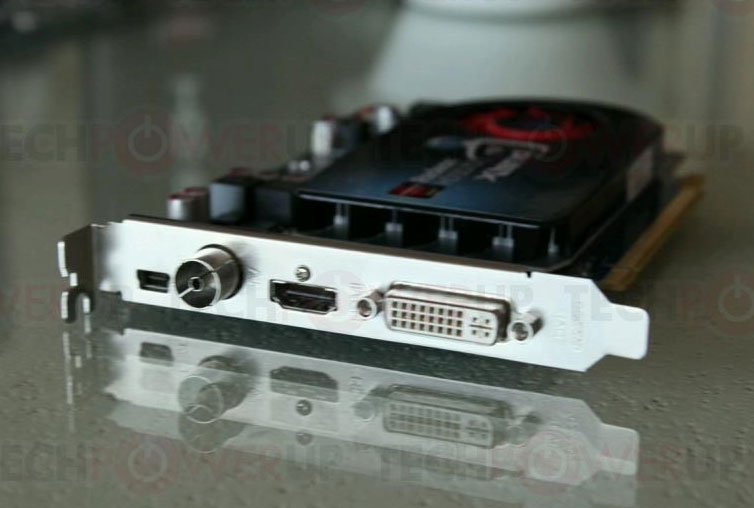
Sapphire is keeping the All-in-Wonder series alive to an extant with its latest graphics card suited for home PCs and HTPCs, the Sapphire HD 5570 Xtend TV. The card is a full-height DirectX 11 compliant Radeon HD 5570 which integrates a standard-definition TV tuner. The tuner can scan for, and store channels, you can also program the software to record them at a set time. As a graphics card, it packs 320 stream processors and 512 MB/1 GB of GDDR3 memory over a 128-bit memory interface.

See more images of the card after the break.

via TechPowerUp

Friday, January 7, 2011

EVGA shows off its GeForce 595 based, dual-GPU graphics card

(EVGA 595 - Image courtesy of The Tech Report)

EVGA wouldn't give us many details about the card in question, but they did say it's a future dual-GPU product. Given that EVGA is an exclusive Nvidia partner, that essentially confirms something we've half expected for some time now: a dual-GPU, SLI-on-a-stick video card must be on the way, presumably as a member of the GeForce GTX 500 series.
As you can see, there are three DVI outputs on the card, made possible by the presence of two GPU display engines. This card should be capable of driving three monitors and allowing games to run across them all at once via Surround Gaming, Nvidia's answer to AMD's Eyefinity.
This is a decidedly high-end product. The card is relatively long and sports a pair of eight-pin auxiliary power connectors, suggesting that a beefy PSU will be needed in order just to run one of these babies.

Judging by our mystery card's apparent power and cooling requirements, we'd expect it to house a pair of GF110 GPUs, perhaps de-tuned a bit from the fastest single-GPU GF110 implementation, the GeForce GTX 580, simply so that two chips can be powered and cooled on a single card. The presence of eight Samsung K4G10325F one-gigabit GDDR5 DRAM chips on the back of the board, four per GPU, means there's at least 1GB of total memory on the card. One possibility is that there are eight matching DRAM chips on the other side of the board, or 1GB per GPU. If true, that would mean only four of each GF110's six memory controller/ROP partition units are enabled. It's also possible there are 12 DRAM chips on the other side of the card, with five memory/ROP units enabled per GPU, making this card more like a pair of GTX 570s. The latter configuration may be more likely.

Read the rest of the article here. See more images of the card after the break.

via TechReport

Thursday, January 6, 2011

Breaking: Razer introduces its Switchblade portable gaming concept.


The most beautiful thing to come out of CES 2011? The show ain't over yet, but we're unafraid to say that Razer's Switchblade is the device to beat. Before you go getting your hopes up, we have to (regretfully) point out that this here gaming handheld is but a concept, but considering that Toshiba's Libretto W105 made it to store shelves (if but for a moment), we're hoping and praying that the Switchblade can also find its way to a production line. Little is known about the device itself, but Razer has imagined it using a pair of 7-inch multitouch displays as well as a layer of tactile, dynamic keys on the lower screen. Much like the Optimus Maximus of yesteryear, this keyboard would enable gamers to place different screens underneath depending on title, and even within a game, you could imagine the keys shifting to account for different POVs, levels, scenarios, etc. Internally, the concept is based around an Intel Atom processor, but there's no word on what kind of GPU would work alongside of it. Sadly, Razer's unwilling to talk pie-in-the-sky details when it comes to price and release, but if four million comments show up below begging and pleading for the company to take this commercial...

via Engadget

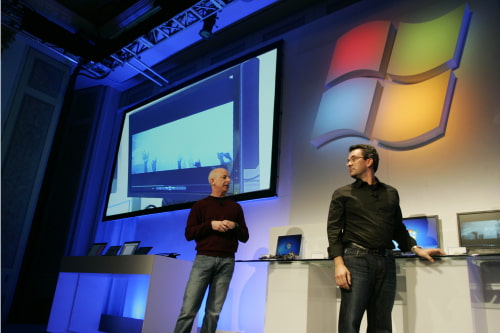
Press Release: Microsoft Announces Support of SoC Architectures From Intel, AMD, and ARM for Next Version of Windows


LAS VEGAS — Jan. 5, 2011 — Microsoft Corp. today announced at 2011 International CES that the next version of Windows will support System on a Chip (SoC) architectures, including ARM-based systems from partners NVIDIA Corp., Qualcomm Inc. and Texas Instruments Inc. On the x86 architecture, Intel Corporation and AMD continue their work on low-power SoC designs that fully support Windows, including support for native x86 applications. SoC architectures will fuel significant innovation across the hardware spectrum when coupled with the depth and breadth of the Windows platform.

At today’s announcement, Microsoft demonstrated the next version of Windows running on new SoC platforms from Intel running on x86 architecture and from NVIDIA, Qualcomm and Texas Instruments on ARM architecture. The technology demonstration included Windows client support across a range of scenarios, such as hardware-accelerated graphics and media playback, hardware-accelerated Web browsing with the latest Microsoft Internet Explorer, USB device support, printing and other features customers have come to expect from their computing experience. Microsoft Office running natively on ARM was also shown as a demonstration of the potential of Windows platform capabilities on ARM architecture.

Continue Reading...

via Microsoft

Breaking: Nvidia finally enters the desktop CPU market. Makes its own ARM based CPUs


NVIDIA announced today that it plans to build high-performance ARM® based CPU cores, designed to support future products ranging from personal computers and servers to workstations and supercomputers.

Known under the internal codename "Project Denver," this initiative features an NVIDIA® CPU running the ARM instruction set, which will be fully integrated on the same chip as the NVIDIA GPU.

This new processor stems from a strategic partnership, also announced today, in which NVIDIA has obtained rights to develop its own high performance CPU cores based on ARM's future processor architecture. In addition, NVIDIA licensed ARM's current Cortex™-A15 processor for its future-generation Tegra® mobile processors.

"ARM is the fastest-growing CPU architecture in history," said Jen-Hsun Huang, president and chief executive officer of NVIDIA. "This marks the beginning of the Internet Everywhere era, where every device provides instant access to the Internet, using advanced CPU cores and rich operating systems.

Continue Reading...

via Nvidia 

Nvidia announces its entire range of GeForce 500M mobile graphics processors


Yes, NVIDIA's naming scheme really is all over the place, but here's what you need to know: as of today, the fastest mobile GPU coming from Jen-Hsun Huang's team will be the GeForce GTX 485. That chip will be equipped with a 256-bit memory interface and GDDR5 RAM and succeed the GTX 480M as the king of the (relatively) mobile castle. Moving up in numbers, but not performance, the new GT 520M, 525M, 540M, 550M, and 555M represent very mild refreshes of their 400M series counterparts. We were initially unimpressed by NVIDIA's decision to keep things stagnant but for some more aggressive clock speeds at the same TDP envelopes, but a recent review of the earlier-launched GT 540M showed appreciable gains from its predecessor, so maybe these graphics gurus actually know what they're doing.

We've gathered some imagery of early units sporting NVIDIA's new graphics hardware -- notably paired with Intel's Sandy Bridge CPUs -- in the galleries below, but we'll surely have more for you as we explore the halls of CES. After all, NVIDIA has an awesome 200 design wins combining its tech with Intel's latest, there should be plenty of previously unseen hardware for us to find. In the mean time, skip past the break to see a couple of benchmark runs showing off NVIDIA's new graphics processors.

via Engadget

Wednesday, January 5, 2011

Nvidia introduces 3DTV Play technology


NVIDIA has today released their 3DTV Play software online for purchase. Consumers who have both an NVIDIA graphics card and a 3D TV are now able to buy the software to run PC games, Blu-Ray’s, and photos all in 3D on their televisions. The software is based on NVIDIA's popular 3D Vision hardware, although this release only requires you to have a 3D TV and compatible 3D glasses.

The 3DTV Play software works if you have both a compatible NVIDIA Graphics card and a HDMI 1.4 based 3D TV from the list that the company provides on their website.

The software doesn't just allow you to play 3D games, but also enables 3D Blu-Ray movie playback, and the ability to view 3D photos on your PC if you have a compatible 3D camera. However the 3DTV Play pack does come with a number of 3D photos for you to try out even if you haven’t gotten around to buying a 3D camera yet. From our early tests with 3D films, the 3DTV Play software does a perfectly good job with films such as Alice in Wonderland and Monster House in 3D.

Continue Reading...

via Neowin 

Sapphire launches their first AMD Fusion based motherboard (Update x3)


Sapphire have just announced their first mainboard based on the new Accelerated Processing Unit (APU) architecture, from Sapphire. They have been working closely with AMD to produce this board, which is called the ‘Pure White Fusion E350M1W’.

This is a mini ITX mainboard which features the E350 Zacate APU from AMD. Zacate is the first generation of APU – a combination of CPU and GPU computing technologies onto a single die to improve the performance of both visual and data-intensive tasks. For the first time it combines high-performance serial computing and parallel graphics processing cores on a single chip. The SAPPHIRE Pure White Fusion E350M1W also uses the companion Hudson-M1 (A50M) Chip from AMD.
The graphics engine of the SAPPHIRE Pure White Fusion E350M1W delivers a full DX 11 feature set over a choice of three display outputs of which any pair can be used concurrently. Maximum resolution is 2560 x 1600 over the D-Sub, and 1920 x 1080 over HDMI or the DVI-D output. The SAPPHIRE Pure White Fusion E350M1W can comfortably display HD video content, and will accelerate content in the latest web browsers and Microsoft Office environments as well as in specific supported applications.

See more images after the break.

Read the rest of the article here.

via Kitgutu

Tuesday, January 4, 2011

Samsung introduces its DDR4 memory. Claims 40% increase in energy efficiency over DDR3


Samsung's famed lead in component manufacturing is being extended today with the announcement of a DDR4 DRAM stick that can perform read and write operations using up to 40 percent less power than the old/current DDR3 stuff. Bandwidth maxes out at 2.13Gbps at 1.2V, while Pseudo Open Drain technology assists in minimizing the battery impact. Over time, Samsung projects the new DRAM modules will hit 4Gbps speeds. It's working away with server makers right now in order to achieve JEDEC certification, but the target market will clearly be laptops and other mobile devices, where energy-frugal memory like this would best be appreciated.


via Engadget

Breaking: AMD officially announces the first Fusion APUs


Is this real? Is this happening? It's been over four years since AMD and ATI completed their $5.4 billion merger with the promise of Fusion hybrid CPU / GPU chips, and after what's seemed like nearly endless delays, the company's delivering here at CES 2011. And it's delivering in a big way -- the first Fusion chips are a direct assault on Intel's Atom and the netbook market, offering what AMD says is better CPU performance, vastly better GPU performance with DirectX11 support, dedicated 1080p HD video processing and HDMI out, and "all day" battery life that can hit 10 or more hours. There are four total chips in two families built around the new "Bobcat" CPU core to start: the "Zacate" E-Series for mainstream laptops, AIOs and small desktops will have an 18W TDP and come in the 1.6GHz dual-core E-350 and the 1.5GHz single-core E-240, while the "Ontario" C-Series for HD netbooks and "other emerging form factors" will clock in at 9W TDP and come in the dual-core 1.0GHz C-50 and the single core 1.2GHz C-30. The "Llano" A-Series designed for mainstream laptops will offer up to four cores and arrive later this year.

Continue Reading...

via Engadget

Monday, January 3, 2011

Can this Windows 7 based gaming handheld from OCOSMOS take on the PSP?

OCOSMOS. Sound familiar? If you were with us for last year's wild ride through the autumn, it most definitely will. For whatever reason, this South Korean company only comes out to play when the world's eyes are watching, and while we've yet to hear a peep about the products it wowed us with just a few months back, the outfit's making a last-second play for attention at this year's gala. All we have to go on so far are the images above and these two details: this unnamed gaming handheld will boast a dual-core Intel processor and run some version of Windows 7. In other words, you can finish up an Excel file right after you plow through a bona fide Windows game. We're hoping to learn more on this guy in due time, and you can bet we'll be grappling for hands-on time once we hit the floor.

via Engadget

Brazos and Sandy Bridge packing MSI Butterfly and Angelow all-in-ones to debut at CES


We just finished reviewing a feature-packed MSI Wind Top, but come CES next week we'll have three more to try: the AE2410, AE2210 and AE2050, each with the very latest silicon inside. Notebook Italia reports that the Taiwanese computer company's using Intel's new Sandy Bridge CPUs in each of its 24- and 22-inch rigs, and grabbed a low-power AMD Brazos APU for the likely budget 20-inch model -- which will reportedly still include a Blu-ray drive like its Core 2 Duo cousin. All three will sport 1080p touchscreen displays and USB 3.0 ports, but also a spiffy new feature called Super Charger that will charge attached USB gadgets even when the computer is off. Innovations, to be sure, but perhaps not as exciting as the concept items pictured above and below -- up top is the MSI Butterfly, which reportedly has a sliding multitouch screen with ten points of contact, and after the break, see the luxurious MSI Angelow. Here's hoping for prices, specs and high-res pictures once we get to the show.

See more images after the break.

via Engadget & SlashGear

The Unfused Journal CES 2011 Coverage


In addition to the high expectations of tech innovation in 2011, CES never fails to spice things up. It's known to be one of the most exciting events of the year, we think CES days should be a global holiday. Anyways, we'll be keeping you up to date with all the related tech news that finds its way out of the Las Vegas Convention Center, and possibly more!

Since CES news will be coming in like a flowing river, you can either view the news as usual on our main page along with the regular daily news posts, or you can head over here to filter our site to show only CES related posts, so you can keep focused on whats breaking.

So brace yourselves, keep your expectations high for they will be fulfilled, and we hope you enjoy this event as much as we will.